
The Employee Provident Fund (EPF) is one of the most reliable and popular long-term retirement savings schemes for salaried employees in India. Managed by the Employees’ Provident Fund Organisation (EPFO), it offers government-backed returns, compounding growth, and tax-free retirement benefits under specified conditions.
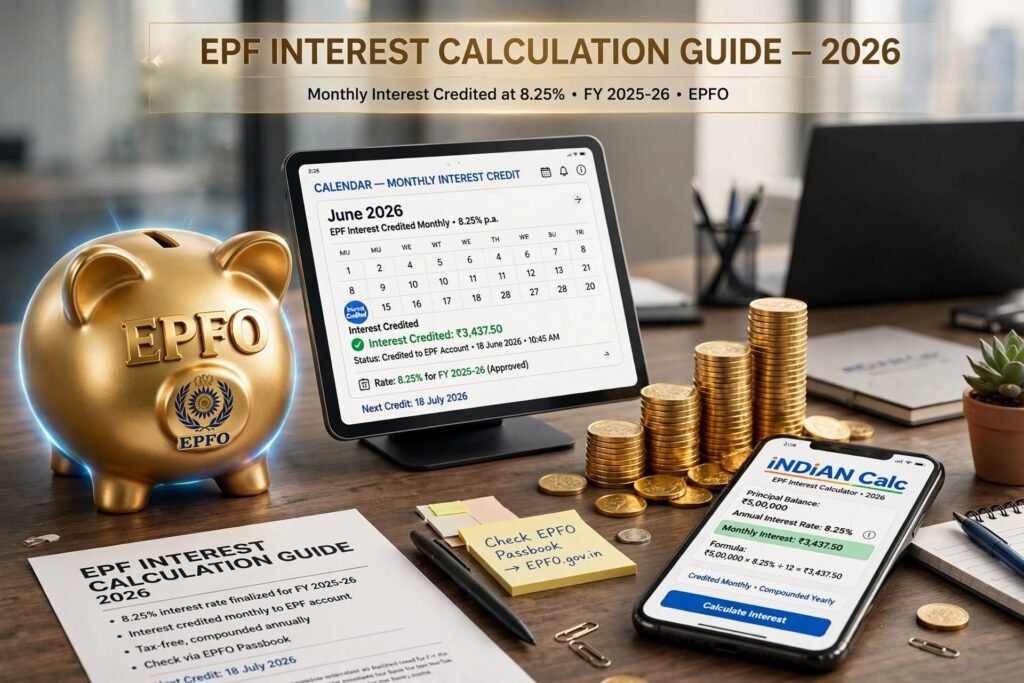
However, many salaried individuals are confused about how their monthly salary deductions translate into their final EPF maturity corpus. How much actually goes into pension? How is interest calculated monthly?
In this comprehensive guide, we break down the step-by-step process of how to calculate EPF interest and maturity amount in 2026.
1. Understanding EPF Contribution Structure
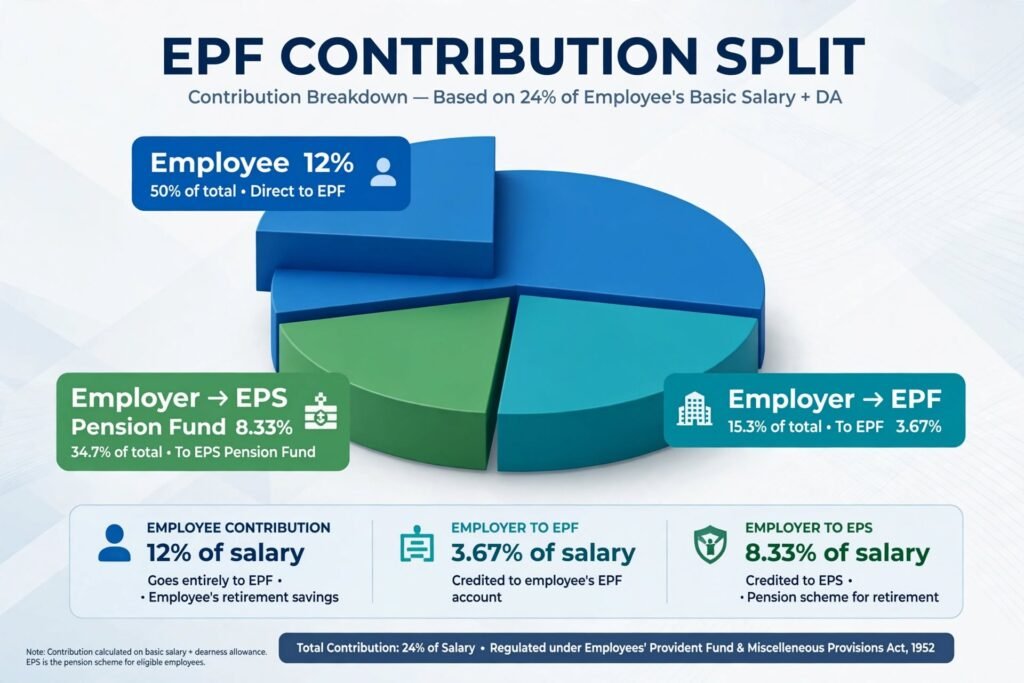
Every month, a fixed percentage of your basic salary plus Dearness Allowance (DA) is contributed toward your provident fund.
- Employee Contribution: 12% of (Basic Salary + DA) goes directly into your EPF account.
- Employer Contribution: 12% of (Basic Salary + DA) is divided into two parts:
- 3.67% goes to your EPF Account.
- 8.33% goes to the Employees’ Pension Scheme (EPS) (capped at ₹1,250/month for a standard wage ceiling of ₹15,000).
Note: Interest is earned only on the total balance in the EPF account (Employee contribution + 3.67% Employer contribution). The EPS portion does not earn interest; it pays out a monthly pension post-retirement.
2. How EPF Interest is Calculated (Monthly vs Yearly)
A common misconception is that EPF interest is calculated annually. While the interest rate is declared on an annual basis by the government, interest is calculated every month on the closing balance and credited to the account at the end of the financial year (March 31st).
Step-by-Step Calculation Example:
Suppose your Basic Salary + DA is ₹30,000, and the EPF interest rate is 8.25% per annum.
- Monthly Employee Contribution (12%): ₹3,600
- Monthly Employer EPF Contribution (3.67%): ₹1,101
- Total Monthly EPF Addition: ₹4,701
- Monthly Interest Rate: $8.25\% \div 12 = 0.6875\%$
| Month | Opening Balance | Monthly Contribution | Total Balance | Interest Calculated (0.6875%) |
| April | ₹0 | ₹4,701 | ₹4,701 | ₹32.32 |
| May | ₹4,701 | ₹4,701 | ₹9,402 | ₹64.64 |
| June | ₹9,402 | ₹4,701 | ₹14,103 | ₹96.96 |
At the end of the financial year, the total accumulated monthly interest is added to your principal balance to form the opening balance for the next financial year.
3. How to Estimate Your Final EPF Maturity Amount

Your final retirement corpus depends on three main variables:
- Current Basic Salary & Expected Annual Increments: As your salary grows, your monthly EPF contribution increases automatically.
- Total Years of Service: Long-term compounding yields massive returns over 20–30 years.
- Voluntary Provident Fund (VPF): You can voluntarily contribute up to 100% of your basic salary to get the same high interest rate.
Using a compounding formula, even a standard monthly contribution of ₹5,000 over 25 years at an 8.25% interest rate can yield a maturity corpus exceeding ₹45 to ₹50 Lakhs.
4. EPF Taxation Rules You Must Know in 2026
- Exemption at Withdrawal: EPF withdrawals are completely tax-free if you complete 5 years of continuous service.
- ₹2.5 Lakh Annual Capping: If your personal contribution to EPF + VPF exceeds ₹2.5 Lakhs in a financial year, the interest earned on the contribution above ₹2.5 Lakhs is taxable as per your income tax slab.
- Premature Withdrawal Tax (TDS): Withdrawing EPF before 5 years of continuous service attracts TDS unless the withdrawal amount is below ₹50,000.
Calculate Your EPF & Retirement Corpus Instantly
Instead of manual calculations, plan your long-term wealth using smart financial tools:
- Check your retirement corpus projections using our free EPF and Retirement Calculator.
- Compare EPF returns with equity growth using our SIP vs Lump Sum Calculator.
- Check your official EPF balance and passbook directly at the EPFO Member Portal.
Frequently Asked Questions (FAQs)
1. Does EPS amount get interest in the EPF passbook?
No, the 8.33% employer contribution that goes into the Employees’ Pension Scheme (EPS) does not accumulate interest. It is used to calculate your monthly pension after retirement based on service duration.
2. Can I increase my EPF contribution to build a bigger corpus?
Yes, you can opt for the Voluntary Provident Fund (VPF). It allows you to contribute up to 100% of your basic salary into the same EPF account, earning the same government-backed interest rate.
3. What happens to my EPF interest if I change jobs?
When you switch jobs, transfer your old EPF balance to your new employer’s EPF account using the Universal Account Number (UAN). Continuous service across multiple employers is counted toward the 5-year tax-free limit.
Disclaimer: The information provided in this article is strictly for educational and informational purposes only. EPF interest rates and tax laws are subject to government revisions. Always verify with official EPFO guidelines or consult a financial professional before making financial decisions.