As the end of the financial year approaches, taxpayers in India look for financial instruments that offer a dual benefit: saving income tax under Section 80C and generating inflation-beating long-term wealth. Among all eligible tax-saving avenues, Equity Linked Savings Schemes (ELSS) remain a top recommendation for investors seeking market-linked growth.

ELSS mutual funds combine equity exposure with a tax deduction of up to ₹1,50,000 per financial year under the Old Tax Regime. With the shortest lock-in period among all Section 80C options, ELSS funds allow your wealth to compound effectively over time.
In this guide, we review the best ELSS tax-saving mutual funds for 2026, their features, and how to invest strategically for maximum returns.
What is an ELSS Mutual Fund?
An Equity Linked Savings Scheme (ELSS) is a category of open-ended mutual funds that invests at least 80% of its total assets in equity and equity-related instruments across market capitalizations (Large Cap, Mid Cap, and Small Cap).
Key Features of ELSS:
- Tax Benefit: Deduct up to ₹1.5 Lakhs from your taxable income under Section 80C (Old Tax Regime).
- Lock-in Period: 3 years (shortest compared to 5 years for Tax-Saving FDs and 15 years for PPF).
- Flexible Investing: You can invest via a Monthly Systematic Investment Plan (SIP) or a Lump Sum investment.
- Capital Appreciation: Since funds are invested in equity markets, long-term returns usually outperform traditional fixed-income instruments.
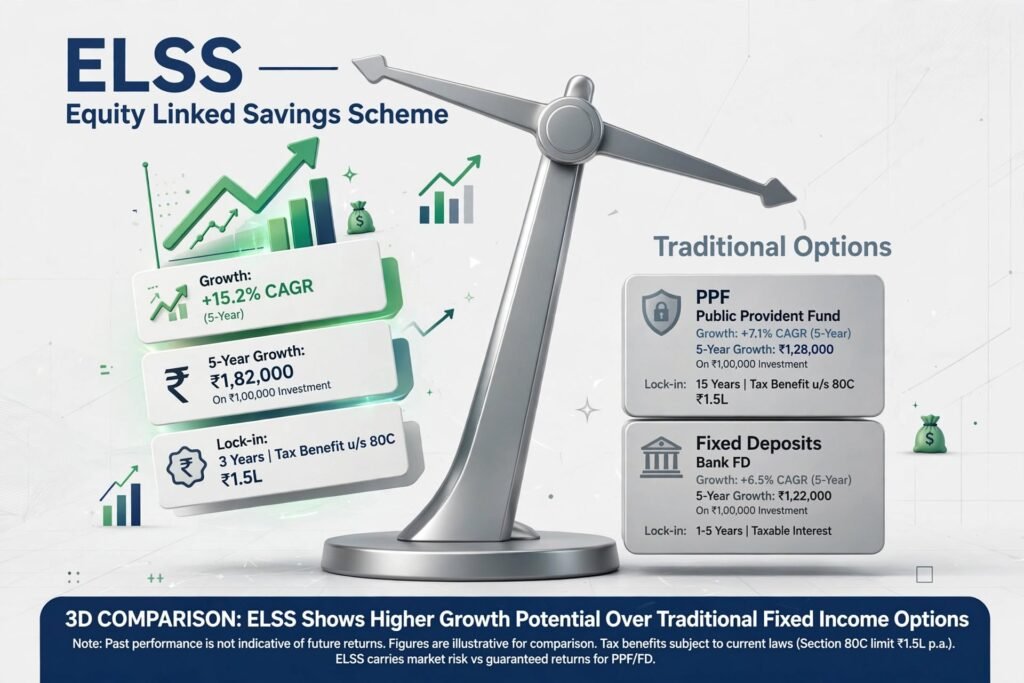
ELSS vs Traditional Tax-Saving Options
| Feature | ELSS Mutual Funds | Public Provident Fund (PPF) | Tax-Saving Fixed Deposit |
| Expected Returns | 12% – 15% (Market-linked) | 7.1% (Government fixed) | 6.5% – 7.5% (Bank fixed) |
| Lock-in Period | 3 Years | 15 Years | 5 Years |
| Risk Level | Equity Risk | Zero Risk | Low Risk |
| Taxability of Gains | LTCG taxable @ 12.5% beyond ₹1.25L | Completely Exempt (EEE) | Taxable as per Income Tax Slab |
How to Select the Best ELSS Fund in 2026
When evaluating ELSS funds, look beyond short-term 1-year returns and focus on these critical parameters:
- 3-Year and 5-Year Rolling Returns: Check how consistently the fund has outperformed its benchmark index across different market cycles.
- Expense Ratio: Lower expense ratios directly increase your net take-home returns over time.
- Fund Manager Track Record: Ensure the fund manager has a proven strategy for navigating bull and bear markets.
- Portfolio Diversification: Review the asset allocation across sectors to ensure balanced risk management.
Smart Strategy: SIP vs Lump Sum in ELSS
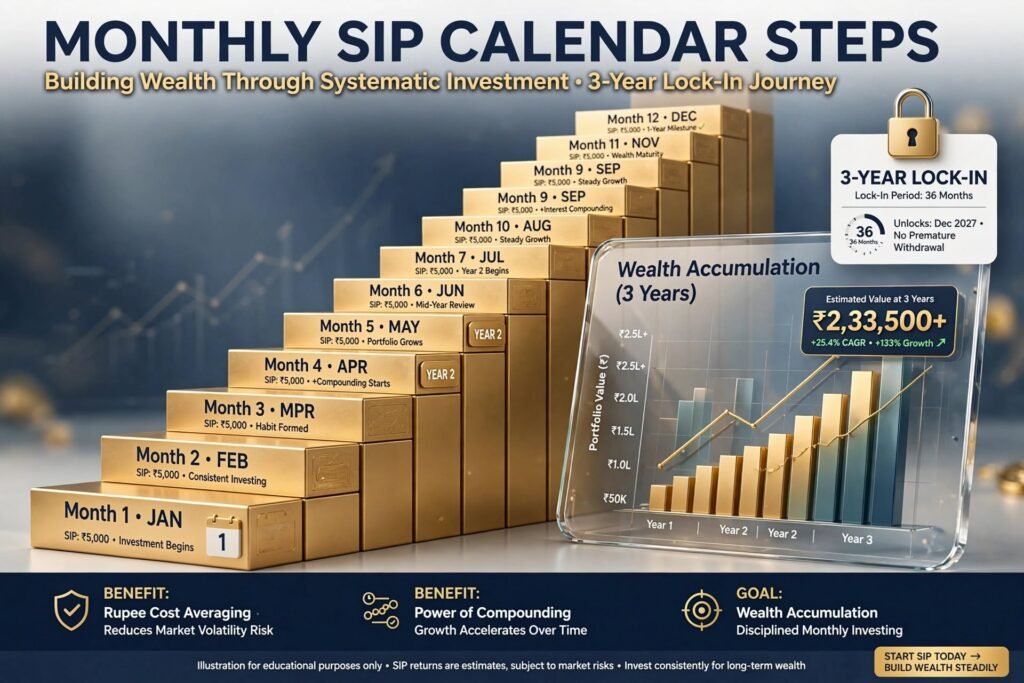
While many investors make a lump sum investment in March to meet their tax-saving deadline, starting a monthly SIP in ELSS at the beginning of the financial year (April) is far more effective:
- Rupee Cost Averaging: Investing monthly neutralizes market volatility by buying more units when prices are low.
- Better Lock-in Management: Each SIP installment carries its own 3-year lock-in period. Starting early prevents a single large lump sum from getting locked altogether at year-end.
Taxation on ELSS Mutual Fund Withdrawal
Under current tax regulations:
- Long-Term Capital Gains (LTCG): Gains up to ₹1.25 Lakh in a financial year are completely tax-free.
- Tax Rate: Any LTCG exceeding ₹1.25 Lakh is taxed at a flat rate of 12.5% without indexation benefits.
Calculate Your Tax Savings & SIP Growth
Plan your tax savings and calculate potential returns before investing:
- Calculate your compounding returns with our free ELSS & SIP Return Calculator.
- Compare tax outgo under different regimes using our Income Tax Calculator.
- Track official mutual fund regulations and guidelines directly at the AMFI India Portal.

Frequently Asked Questions (FAQs)
1. Can I redeem my ELSS investment after 3 years?
Yes, after completing the mandatory 3-year lock-in period, you can redeem your units. However, if your financial goals permit, staying invested longer yields better compounding equity growth.
2. Is ELSS beneficial under the New Tax Regime?
Tax deductions under Section 80C (including ELSS) are available primarily under the Old Tax Regime. If you opt for the New Tax Regime, you cannot claim the ₹1.5 Lakh tax deduction, though ELSS remains an excellent open-ended equity fund choice post lock-in.
3. What happens to my SIP installments after 3 years?
Each monthly SIP installment has an independent 3-year lock-in. For example, an installment made in April 2026 can be redeemed in April 2029, while the May 2026 installment unlocks in May 2029.
Disclaimer: Mutual fund investments are subject to market risks; read all scheme-related documents carefully. The information provided is for educational purposes only and should not be considered direct financial advice.