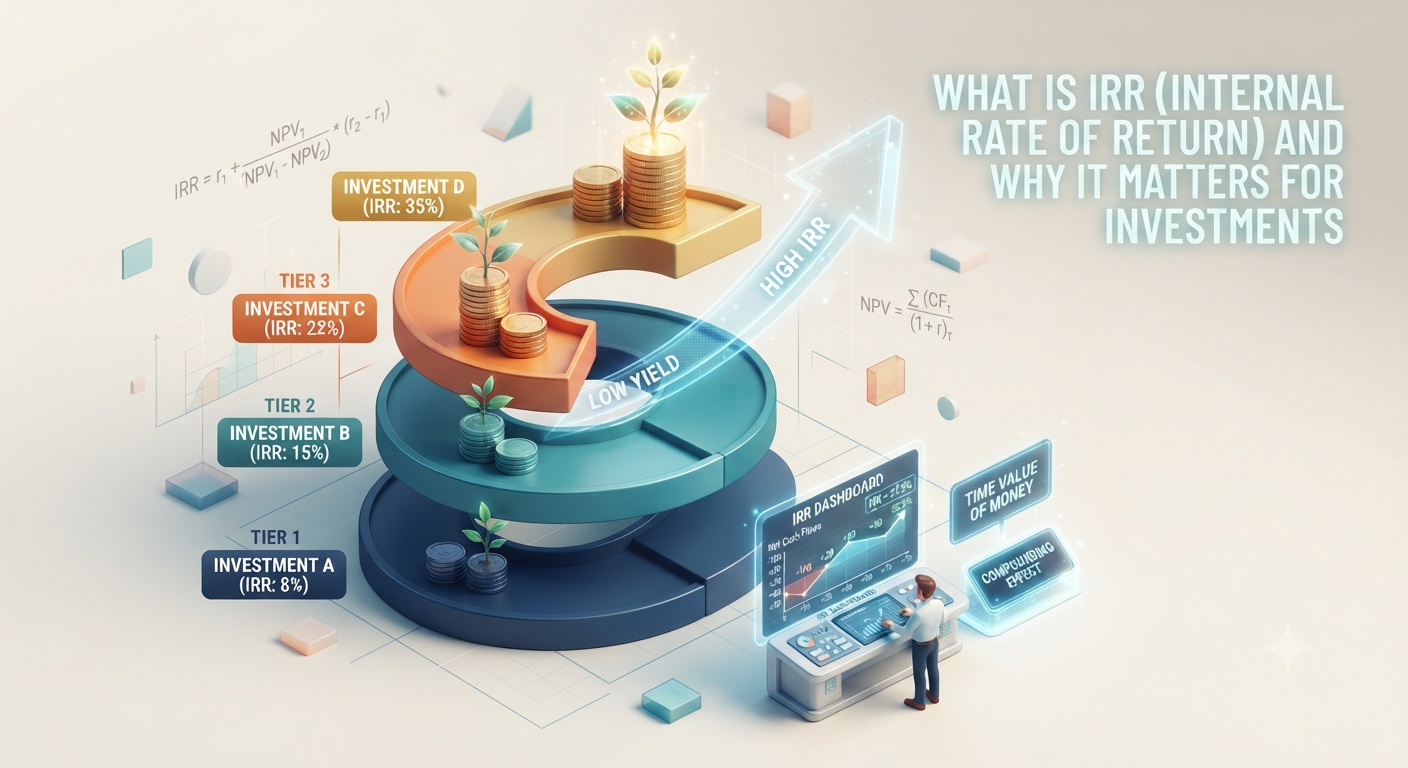
When it comes to growing your wealth, understanding how to measure the performance of your investments is crucial. While absolute returns show you the total profit made, they often fail to account for the time value of money, especially when investments involve multiple cash flows over several years.
This is where the Internal Rate of Return (IRR) comes into play. In this guide, we will break down what IRR means, how it works, and why savvy investors rely on it.
What is IRR (Internal Rate of Return)?
IRR is a metric used in financial analysis to estimate the profitability of potential investments. Technically, IRR is the discount rate that makes the Net Present Value (NPV) of all cash flows equal to zero.
In simpler terms, IRR is the annualized effective compound return rate that an investment generates over its lifespan. Whether you are investing in real estate, stocks, mutual funds, or business projects, IRR helps you compare different opportunities on a level playing field.
Why is IRR Important for Investors?
- Accounts for Time Value of Money: Money today is worth more than the same amount in the future. IRR factors in when cash is invested and when returns are received.
- Handles Multiple Cash Flows: Unlike simple growth formulas, IRR can easily calculate returns when you make irregular or multiple deposits (like SIPs or staggered project funding).
- Better Comparative Analysis: It allows investors to compare completely different investment avenues—such as a 5-year fixed deposit versus a fluctuating business venture—using a single percentage metric.
Simple Ways to Make the Most of IRR
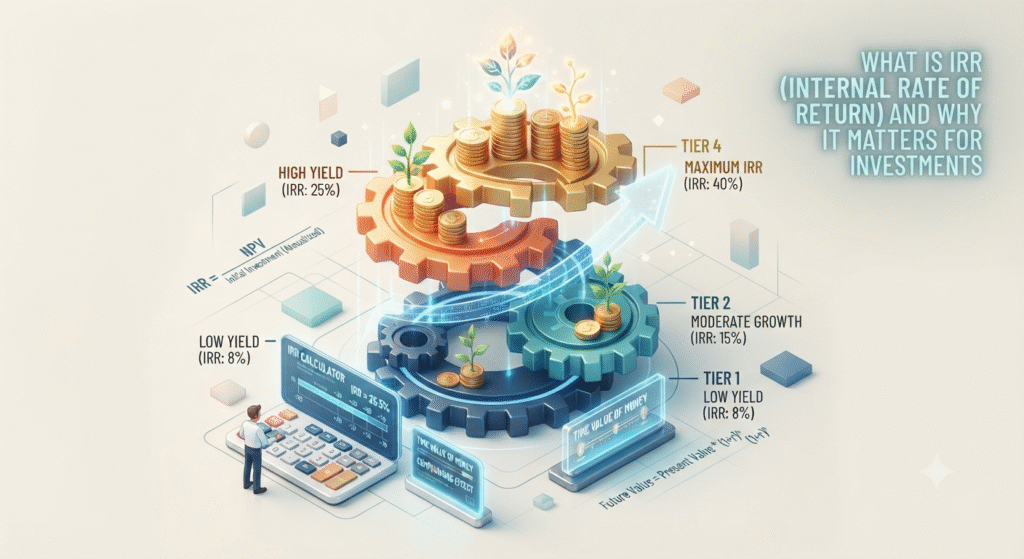
- Look Beyond Absolute Returns: Don’t just look at the final lump sum amount; check the annualized IRR to see how efficiently your money worked each year.
- Evaluate Long-Term Projects: If you are investing in assets that lock up capital for years, use IRR to judge if the annualized yield beats inflation and other standard benchmarks.
- Reinvestment Rate Awareness: Keep in mind that IRR assumes intermediate cash flows are reinvested at the same rate, so always look at realistic projections.
How to Calculate Your Investment Returns Instantly?
Manually calculating IRR involves complex algebraic formulas and trial-and-error discount rates. Instead, you can get accurate results within seconds by using our free online IRR Calculator to evaluate your cash flows effortlessly!
Conclusion
Understanding metrics like IRR empowers you to make smarter, data-driven financial decisions rather than relying on guesswork. By tracking your returns accurately, you can optimize your portfolio for maximum long-term growth.
Explore all our free financial, loan, and health calculators at Muskan Enterprises to plan your financial journey today!