
Meta Description: Discover how compound interest works and why Albert Einstein called it the eighth wonder of the world. Learn how small, regular savings grow into massive wealth over time.

Introduction: The Magic of Time and Money
Have you ever wondered how ordinary people manage to build massive financial corpora over the years, starting with very modest incomes? The secret does not lie in winning a lottery or striking gold overnight; rather, it lies in understanding and utilizing one of the most powerful forces in human economics: Compound Interest.
Often referred to colloquially as the “snowball effect,” compound interest is the ultimate engine behind long-term wealth creation. Whether you are saving for your child’s education, planning an early retirement, or investing in mutual funds via SIPs, compounding is the silent partner working behind the scenes. In this comprehensive guide, we will break down what compound interest is, how it differs from simple interest, and how you can make it work for you.
What is Compound Interest? (Simple vs. Compound)
To truly appreciate compounding, we first need to understand how interest is calculated in the financial world:
- Simple Interest: Interest is calculated only on the initial principal amount you deposited or borrowed. If you invest $1,000 at 10% simple interest, you earn $100 every single year, regardless of how long the money sits there. The earnings remain flat.
- Compound Interest: Interest is calculated on the principal amount plus all the accumulated interest from previous periods. In simple terms, you earn “interest on interest.”
As Albert Einstein famously noted: “Compound interest is the eighth wonder of the world. He who understands it, earns it; he who doesn’t, pays it.”

How Compounding Works: A Real-World Example
Let’s look at a practical comparison to see how compounding transforms wealth over time:
Suppose Investor A and Investor B both invest money at an expected annual return of 12%:
- Investor A starts early and invests $200 per month starting at age 25 and stops investing at age 35 (10 years total). Total money invested = $24,000.
- Investor B starts late and invests $200 per month starting at age 35 and continues all the way until age 65 (30 years total). Total money invested = $72,000.
By the time both reach age 65, due to the sheer power of time and compounding, Investor A (who invested three times less money overall but started 10 years earlier) will often end up with a significantly larger or comparable portfolio than Investor B. Time in the market always beats timing the market!
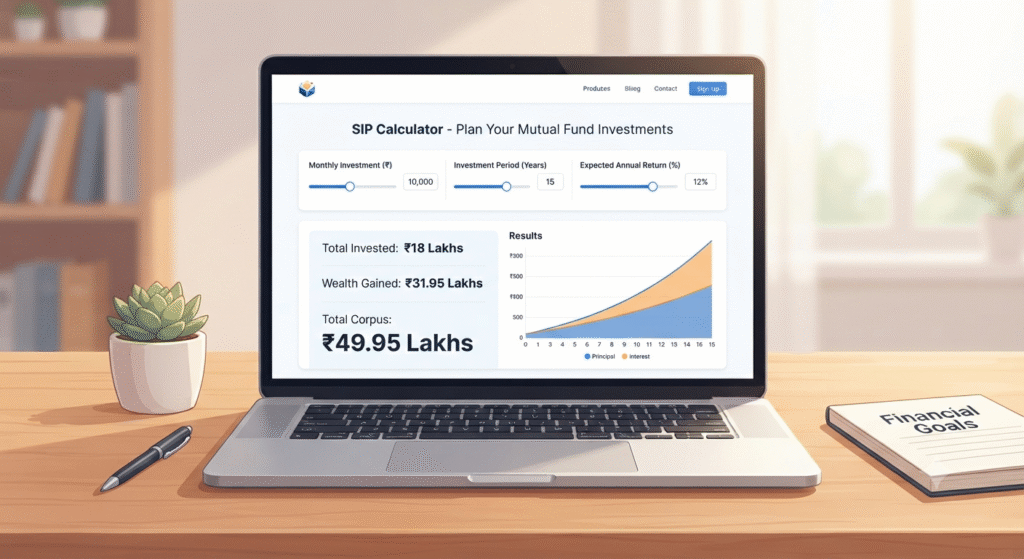
(You can simulate your own timeline using the iNDiAN Calc SIP and Investment Calculators to see how compounding scales your money).
The Rule of 72: A Quick Mental Math Trick for Investors
If you want to quickly calculate how long it will take for your investment to double at a specific fixed compound interest rate, financial analysts use a brilliant shortcut called the Rule of 72.
The Formula:
$$\text{Years to Double} = \frac{72}{\text{Annual Interest Rate (\%)}}$$
Example:
- If your investment is growing at an average rate of 8% per year, divide 72 by 8:$72 / 8 = \mathbf{9\text{ years}}$. Your money will double in approximately 9 years.
- If your return rate is 12% per year:$72 / 12 = \mathbf{6\text{ years}}$. Your money will double in just 6 years.
This simple rule helps investors evaluate whether an asset aligns with their target timeline milestones.
4 Golden Rules to Maximize Compound Interest
- Start As Early As Possible: As seen in our example, time is your greatest asset. Even starting with a tiny amount in your early twenties beats waiting to invest larger sums later.
- Never Interrupt the Compounding Cycle: Cashing out early breaks the compounding chain. Let your returns accumulate uninterrupted over long horizons.
- Reinvest Your Dividends & Earnings: Ensure that any payouts, dividends, or interest earned are automatically reinvested back into the primary asset to maximize growth.
- Increase Contributions Over Time (Step-Up): As your career progresses and income grows, increase your monthly contributions incrementally each year to supercharge your compound growth.
Conclusion
Compound interest is proof that small, consistent habits lead to extraordinary results over time. You do not need a massive fortune to start building wealth; you just need patience, discipline, and a clear understanding of how time multiplies capital. Start early, stay consistent, and let compounding do the heavy lifting for your financial future.
Disclaimer: This article is for informational and educational purposes only. Investment returns are subject to market risks; consult a certified financial advisor before committing capital.