

Every working professional and small business owner looks forward to the first day of the month. The instant SMS notification confirming your monthly paycheck credit brings a genuine sense of financial relief, but it is almost immediately followed by a fundamental question: what is my actual net take-home pay after all statutory deductions? Over the past few months, sweeping structural transformations across India’s economic ecosystem, tax administration, and consumer retail markets have completely reshaped how everyday household budgets function. If you are trying to compute your net monthly savings today, leveraging the New GST Slabs Tax Benefit Calculator 2026 provides an instant, mathematically accurate breakdown of your updated disposable income.
With the official rollout of the GST Rate Changes & New Tax Act 2026, every salaried employee and self-employed individual is experiencing a direct, positive shift in monthly savings, purchasing power, and long-term capital accumulation. Whether you are buying monthly groceries at a hypermarket, paying for family health insurance coverage, evaluating auto loan terms for a new family car, or reviewing your monthly salary slip, understanding this dual synergy of reduced indirect taxes and updated income tax slabs is essential. Through the New GST Slabs Tax Benefit Calculator 2026, you can easily evaluate how much extra cash remains in your bank account at the end of every billing cycle.
1. GST Slabs Modernization 2026: What Has Changed in India’s Indirect Tax Architecture?
To streamline national indirect taxation, eliminate cascading tax burdens, and significantly lower the daily cost of living for middle-class families, the Goods and Services Tax Council officially phased out the historical 4-tier system (5%, 12%, 18%, and 28%). In its place, the council introduced a modern, simplified 3-Tier GST Slab Structure (0%, 5%, 18%, and 40%).
More than 200 essential consumer goods previously taxed under the 12% and 28% categories have been permanently migrated into lower, merit-based tax brackets. When assessing your family’s monthly retail budget, integrating your figures into a New GST Slabs Tax Benefit Calculator 2026 helps isolate the exact net savings achieved through reduced tax levies across various daily shopping touchpoints.
Comprehensive Breakdown of Updated GST Slabs:
- 0% Category (Nil-Rated & Fully Exempted): Critical life-saving medicines, individual health insurance policies, family floater medical covers, standalone term life insurance, UHT milk, unbranded paneer, fresh food grains, and basic educational stationery.
- 5% Category (Merit Rate Slabs): Packaged food products (biscuits, namkeen, butter, ghee, edible oils), personal hygiene items (toothpaste, soaps, shampoos, hair oil), agricultural equipment, tractors, and budget hotel rooms priced under ₹7,500 per night.
- 18% Category (Standard Universal Rate): Consumer durables (air conditioners, refrigerators, televisions, washing machines), entry-level automobiles, commuter motorbikes up to 350cc, construction cement, IT hardware, and corporate consultancy services.
- 40% Category (De-Merit & Sin Tax Slabs): High-end luxury automobiles, sports motorcycles above 350cc, tobacco products, pan masala, aerated sugary beverages, and online real-money gaming activities.
By analyzing these updated rates with the New GST Slabs Tax Benefit Calculator 2026, consumers can instantly see why their monthly checkout bills at supermarkets have dropped significantly compared to previous years.
2. New Tax Act 2026 and Your In-Hand Take-Home Salary Connection
Direct income tax reforms introduced under the New Tax Act work hand-in-hand with these indirect GST rate reductions. When calculating gross salary deductions, your final net take-home compensation depends heavily on your taxable income threshold after applying statutory exemptions and government rebates.
According to live financial breakdown models on the iNDiAN Calc Salary Calculator, salaried professionals earning up to ₹7,00,000 annually receive a full tax rebate under Section 87A of the Income Tax Act. When combined with the standard deduction of ₹75,000 available to salaried employees under the New Tax Regime, total annual gross pay up to ₹7,75,000 attracts zero direct income tax withholding.
Gross Annual Pay: ₹7,75,000
Less Standard Deduction: -₹75,000
Net Taxable Income: ₹7,00,000
Tax Liability after Sec 87A Rebate: ₹0 (Zero Direct Tax)
When direct withholding tax (TDS) on your monthly paycheck drops to zero and daily retail goods transition from 12% or 18% down to 5% GST, your real-world purchasing power rises by 15% to 20%. Evaluating these variables using the New GST Slabs Tax Benefit Calculator 2026 gives you a complete, holistic view of your monthly financial growth.
3. Real-Life Monthly Budget Comparison: Old vs New Tax Architecture
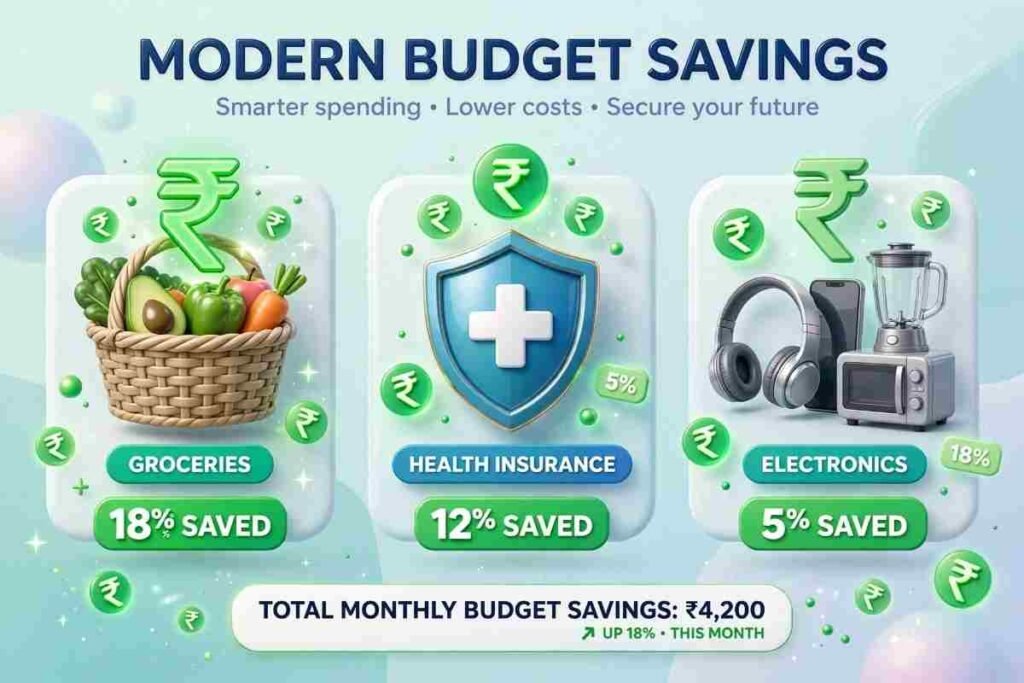
To appreciate the practical impact of these policy changes, let us examine a scenario featuring a salaried corporate employee earning a gross monthly salary of ₹65,000 (annual gross pay of ₹7,80,000) who spends approximately ₹20,000 every month on household groceries, health insurance, utilities, and personal care items.
| Monthly Budget Expense Category | Previous Tax Rules | Updated Tax Architecture (GST 2.0 & Tax Act 2026) | Direct Monthly Cash Savings |
| Monthly Income Tax Withholding (TDS) | ₹1,200 / month deducted | ₹0 (Zero Tax via Sec 87A Rebate) | ₹1,200 saved directly |
| Health Insurance Policy Premium GST | 18% GST (approx. ₹360/mo) | 0% GST (Nil-Rated Category) | ₹360 saved directly |
| FMCG & Grocery Basket (Soaps, Oils, Food) | 12% to 18% GST | 5% GST (Merit Slab) | ₹900 saved directly |
| Consumer Electronics EMI Base | 28% GST | 18% GST (Standard Slab) | ₹1,400 saved directly |
| Total Monthly Retained Cash | – | – | ₹3,860 to ₹4,000 / Month |
By running your personal salary and expense figures through the New GST Slabs Tax Benefit Calculator 2026, you can project your annual household surplus and plan long-term investments accordingly.
4. Top 5 Practical Financial Benefits of the 2026 Tax Overhaul
Benefit 1: 100% Tax-Free Medical and Health Insurance
Eliminating the 18% GST burden on individual and family health insurance policies lowers healthcare access costs for senior citizens and young families alike. This single policy change saves average middle-class families thousands of rupees during annual policy renewals.
Benefit 2: Essential Life-Saving Medicines Become Cheaper
Critical life-saving medications are now completely exempt from GST (0%), while essential oncology and chronic illness treatment drugs have seen rates slashed from 12% down to 5%.
Benefit 3: Reduced Costs for Home Construction and Two-Wheelers
Basic raw materials like cement, along with entry-level commuter motorbikes (under 350cc) and compact cars, now fall under the 18% bracket instead of the peak 28% rate, making home building and personal mobility far more accessible.
Benefit 4: Lower Prices on Essential Home Appliances
Routine household electronics like refrigerators, smart televisions, air conditioners, and washing machines are now taxed at 18%, down from 28%, significantly lowering the upfront cost of setting up a home.
Benefit 5: Simplified Accounting for MSMEs and Retailers
Removing intermediate 12% tax rates enables small and medium enterprises (MSMEs) to process billing faster, claim Input Tax Credit (ITC) efficiently, and verify statutory filings directly on the official CBIC Official Portal.
5. Detailed Case Study: Step-by-Step In-Hand Pay Breakdown
Understanding how statutory deductions impact your paycheck requires looking at a standard monthly compensation structure. Below is a detailed breakdown comparing gross corporate earnings with net bank realizations.
Sample Compensation Structure (Salaried Employee):
- Gross Monthly Pay: ₹65,000
- Basic Pay (50% of Gross): ₹32,500
- House Rent Allowance (HRA – 30%): ₹19,500
- Special Allowances & Perks: ₹13,000
- Employee EPF Deduction (12% of Basic): -₹3,900
- Professional Tax (PT): -₹200
- Estimated Monthly Income Tax (TDS under Sec 87A): ₹0
- Net Monthly Take-Home Pay: ₹60,900 / Month
When you apply the New GST Slabs Tax Benefit Calculator 2026 to your consumer spending after receiving that ₹60,900 in your account, the purchasing power of that money increases further because your daily expenditures carry lower indirect tax levies.
6. How to Use the New GST Slabs Tax Benefit Calculator 2026 and Salary Engines Online
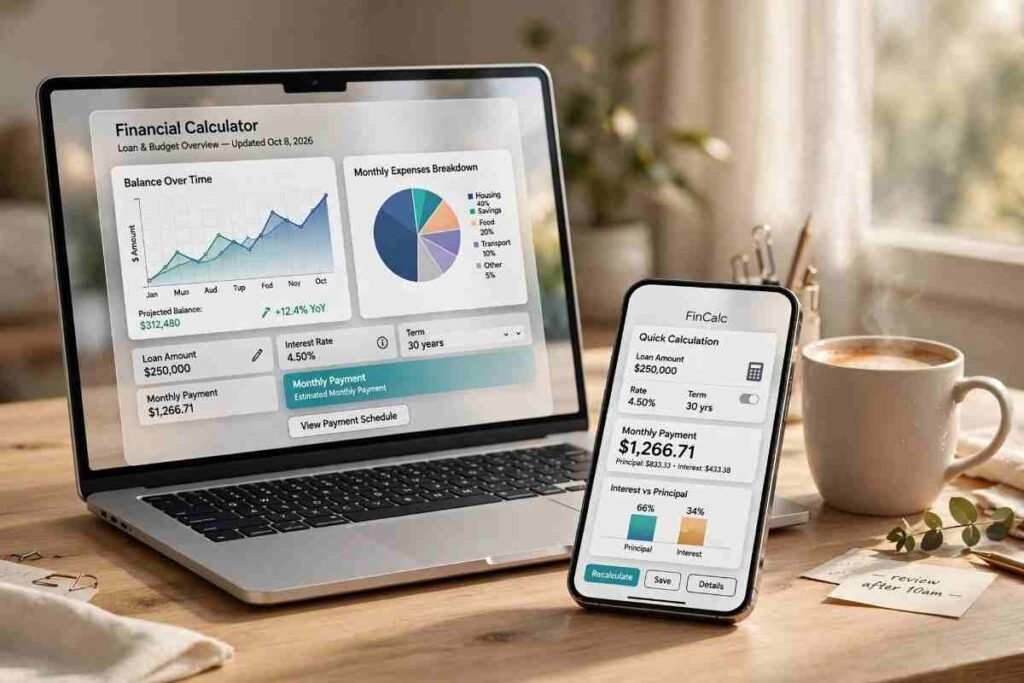
Calculating your savings manually with pen and paper can be time-consuming, but using web-based computational tools makes the entire process seamless:
- Navigate to the iNDiAN Calc Home Page and choose your preferred language (English, Hindi, or Bengali).
- Click on the Salary Calculator tab and enter your Basic Salary, HRA, and Special Allowances. The engine will instantly calculate your Employee Provident Fund (EPF) deduction and monthly income tax withholding (TDS).
- Switch over to the VAT / GST Calculator module. Enter your purchase amount and toggle between “Add Tax” or “Remove Tax” using the New GST Slabs Tax Benefit Calculator 2026 rates (5% or 18%) to derive your exact base price and tax component.
- If you plan to buy a home or car with your extra savings, use our reducing-balance Loan EMI Calculator to estimate your monthly loan repayment schedules accurately.
7. Mathematical Formula: Removing GST from Tax-Inclusive Invoices
For business owners, retailers, and accounting professionals, calculating the exact pre-tax base cost from Maximum Retail Price (MRP) invoices requires using mathematically sound accounting formulas. A common mistake in commercial accounting is subtracting 5% or 18% directly from the final total bill, which produces inaccurate tax entries.
The mathematically verified accounting formula used by the New GST Slabs Tax Benefit Calculator 2026 is:
$$\text{Base Amount} = \frac{\text{Total MRP Inclusive Price}}{1 + \left( \frac{\text{GST Rate}}{100} \right)}$$
$$\text{GST Tax Component} = \text{Total MRP Inclusive Price} – \text{Base Amount}$$
Practical Accounting Example:
If you purchase an electronic item priced at ₹1,180 inclusive of 18% GST:
$$\text{Base Amount} = \frac{1,180}{1 + 0.18} = \frac{1,180}{1.18} = ₹1,000$$
$$\text{GST Amount} = ₹1,180 – ₹1,000 = ₹180$$
Using this exact formula ensures your business stays compliant with official updates published on the Income Tax India Portal.
8. Strategic Wealth Planning: How to Invest Your Extra Tax Savings

Saving money through lower tax liabilities is a great first step, but putting those savings to work is what builds long-term financial security. Here are three practical ways to invest the extra cash calculated by the New GST Slabs Tax Benefit Calculator 2026:
Strategy A: Pay Off High-Interest Debt First
If you carry credit card balances or high-interest personal loans, direct your monthly tax savings toward principal prepayments. Clearing debt early offers an immediate, guaranteed return equal to the interest rate on that debt.
Strategy B: Set Up Automated Monthly SIPs
Investing ₹3,500 every month into Equity Linked Savings Schemes (ELSS) or broad-market index mutual funds through a Systematic Investment Plan (SIP) can build substantial wealth over time.
Monthly Investment: ₹3,500
Investment Horizon: 15 Years
Assumed Annual Growth (CAGR): 12%
Estimated Wealth Accumulated: ~₹17,65,000
Strategy C: Build a 6-Month Emergency Liquid Fund
Before locking capital into long-term investments, ensure you maintain liquid cash reserves equal to at least 6 months of baseline household living expenses in a high-yield savings account or liquid mutual fund.
9. Sector-Wise Impact of the 2026 GST Slabs Modernization
To understand how different industries are affected, let us examine the sector-by-sector breakdown:
Fast-Moving Consumer Goods (FMCG)
With packaged foods, soaps, and cooking oils moving into the 5% merit slab, FMCG manufacturers have seen increased purchase volumes. Lower shelf prices encourage consumers to buy larger pack sizes, boosting retail activity across urban and rural markets.
Real Estate and Housing Construction
Moving construction cement from 28% to 18% has significantly reduced total building costs. Developers are passing these savings on to homebuyers, making residential property acquisitions more affordable.
Automobile and Mobility Sector
While entry-level cars and motorbikes under 350cc enjoy reduced 18% tax rates, luxury sports cars and high-capacity motorcycles face a 40% rate. This structure offers tax relief to working-class commuters while keeping luxury purchases appropriately taxed.
Frequently Asked Questions (FAQs)
Q1. Is annual salary up to ₹7.75 Lakh completely tax-free under the New Tax Regime?
Yes. For salaried employees, the standard deduction of ₹75,000 combined with the full tax rebate under Section 87A ensures that annual earnings up to ₹7,75,000 incur zero direct income tax liability. You can verify your exact numbers using the New GST Slabs Tax Benefit Calculator 2026 and salary engine on our portal.
Q2. Which consumer products attract the 40% GST rate?
The 40% rate applies exclusively to luxury items and sin goods, including motorcycles with engine capacities over 350cc, luxury sports cars, aerated sugary drinks, tobacco products, pan masala, casino operations, and online real-money gaming.
Q3. Are merchants required by law to lower prices when GST drops?
Yes. Under Section 171 (Anti-Profiteering Provisions) of the Central Goods and Services Tax Act, businesses must pass the full benefit of any tax rate reduction directly to end consumers by lowering Maximum Retail Prices (MRP).
Q4. How does the New GST Slabs Tax Benefit Calculator 2026 handle tax-inclusive invoices?
The tool divides your total bill amount by $(1 + \text{Tax Rate} / 100)$ to separate the pre-tax base cost from the actual GST component instantly.
Q5. Can I use the salary calculator for both Indian and Bangladeshi payrolls?
Yes! The multi-utility engine on our portal lets you switch between India 🇮🇳 (INR ₹) and Bangladesh 🇧🇧 (BDT ৳) to compute take-home pay, local land conversions, and statutory deductions accurately.
Conclusion
The 2026 fiscal reforms offer clear financial benefits for Indian taxpayers and consumers. Lower direct tax liabilities under updated Income Tax rules help you keep more of your monthly paycheck, while restructured GST slabs make everyday goods and services more affordable.
To calculate your exact net pay, analyze consumer tax savings, and plan your household budget with confidence, check out the free tools on our iNDiAN Calc Multi-Utility Portal today!