There was a time when earning over ₹10 lakh a year automatically meant handing over a chunk of your paycheck to the tax department. Salaried professionals spent every January collecting investment receipts—LIC policies, PPF passbooks, ELSS mutual funds, and medical bills—just to squeeze into lower tax brackets.
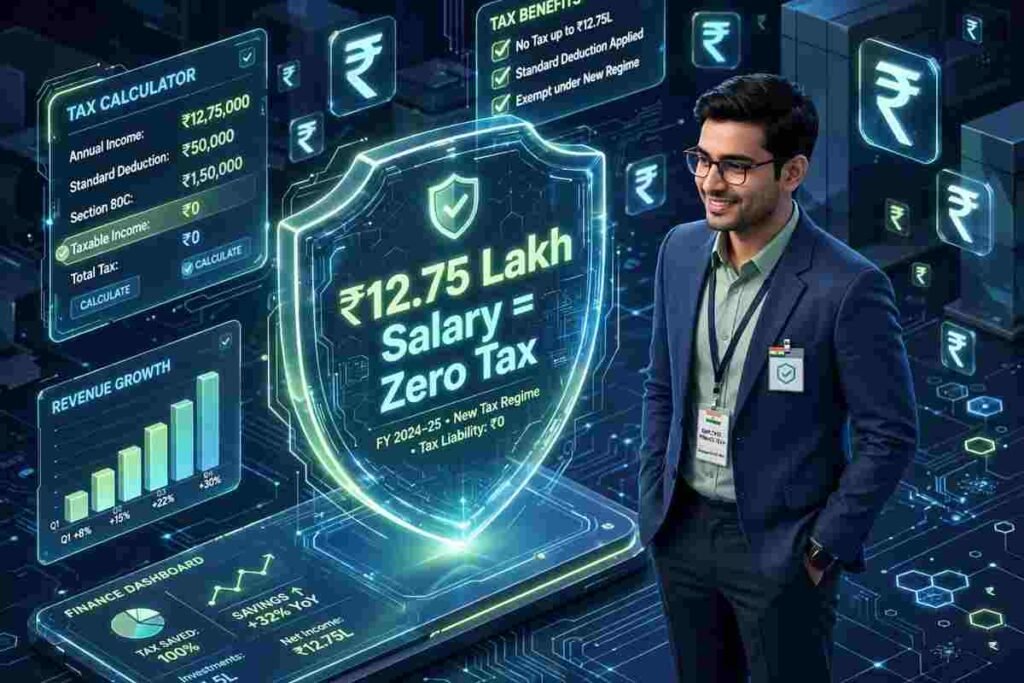
Under the latest updates to the New Tax Regime, the rules of personal finance have shifted dramatically. A salaried employee earning a gross annual compensation of ₹12,75,000 can walk away paying zero rupees in income tax, all without locking a single rupee into mandatory 5-year lock-in products.
Navigating this benefit requires understanding how the numbers fit together—especially as employers finalize payrolls for Quarter 2 and prepare for October TDS salary return compliance 2026 (Quarter 2 TDS filing under Form 138). Understanding the exact breakdown of the 12.75 lakh salary tax calculation 2026 ensures your employer does not deduct excess TDS from your monthly paychecks.
The Core Equation: Standard Deduction Meets Section 87A
How does ₹12.75 lakh turn into zero taxable liability? It boils down to two distinct provisions working in tandem within the Income Tax Department tax framework:
- The ₹75,000 Standard Deduction: Applied automatically to salaried individuals and pensioners, reducing gross income before tax slabs are calculated.
- The Enhanced Section 87A Tax Rebate: A tax rebate that offsets tax liability up to ₹60,000 for net taxable incomes up to ₹12,00,000.
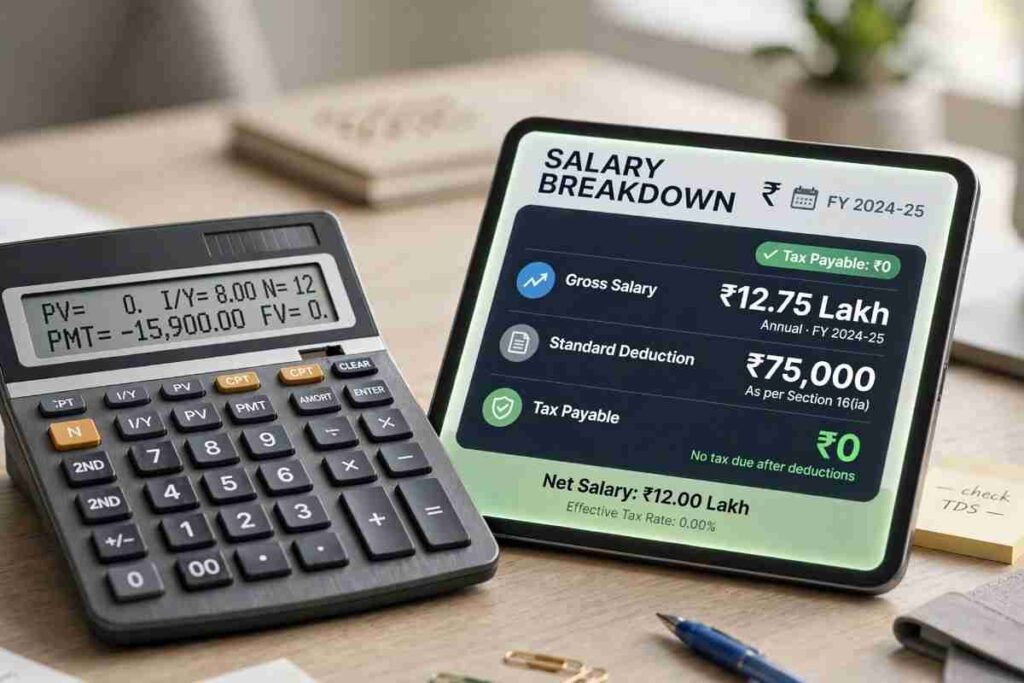
 Gross Salary:            ₹12,75,000
 Less Standard Deduction: - ₹75,000
 ----------------------------------
 Net Taxable Income:      ₹12,00,000  ---> Qualifies for Full Section 87A Rebate (₹60,000)
 Total Income Tax Due:    ₹0
Step-by-Step Breakdown: The 12.75 Lakh Salary Tax Calculation 2026
To understand why this works, examine how tax rates are applied across the revised slabs under the New Tax Regime for FY 2025-26 / AY 2026-27:
- Up to ₹4,00,000: 0% (Nil)
- ₹4,00,001 to ₹8,00,000: 5%
- ₹8,00,001 to ₹12,00,000: 10%
- ₹12,00,001 to ₹16,00,000: 15%
- ₹16,00,001 to ₹20,00,000: 20%
- ₹20,00,001 to ₹24,00,000: 25%
- Above ₹24,00,000: 30%
Applying these slabs to a gross salary of ₹12,75,000 reveals how the tax is calculated:
Step 1: Compute Net Taxable Income
Subtract the standard deduction of ₹75,000 from the gross salary:
$$\text{Gross Salary} – \text{Standard Deduction} = ₹12,75,000 – ₹75,000 = ₹12,00,000$$
Step 2: Calculate Slab-Wise Tax
Now, calculate the gross tax on the ₹12,00,000 net taxable income:
| Income Slab Range | Applicable Rate | Income in Slab | Calculated Tax Amount |
| ₹0 to ₹4,00,000 | 0% | ₹4,00,000 | ₹0 |
| ₹4,00,001 to ₹8,00,000 | 5% | ₹4,00,000 | ₹20,000 |
| ₹8,00,001 to ₹12,00,000 | 10% | ₹4,00,000 | ₹40,000 |
| Total Gross Tax | — | — | ₹60,000 |
Step 3: Apply the Section 87A Tax Rebate
Because the net taxable income after the standard deduction equals exactly ₹12,00,000, the employee qualifies for the full rebate under Section 87A (maximum rebate cap: ₹60,000).
$$\text{Gross Tax} (₹60,000) – \text{Rebate u/s 87A} (₹60,000) = ₹0\text{ Net Payable Tax}$$
No tax, no health and education cess, and no mandatory lock-in investments required.
Old Tax Regime vs. New Tax Regime: Side-by-Side Comparison

While the New Tax Regime is the default option, employees retain the right to switch to the Old Tax Regime. The Old Regime relies on deductions under Chapter VI-A (such as Section 80C, 80D, and HRA).
Comparing both regimes for a gross salary of ₹12,75,000 highlights the differences:
| Parameter / Deduction | Old Tax Regime | New Tax Regime |
| Gross Salary | ₹12,75,000 | ₹12,75,000 |
| Standard Deduction | ₹50,000 | ₹75,000 |
| Section 80C (PPF, ELSS, EPF) | ₹1,50,000 (Claimed) | ₹0 (Not Allowed) |
| Section 80D (Health Insurance) | ₹25,000 (Claimed) | ₹0 (Not Allowed) |
| HRA / Section 24(b) Home Loan Interest | ₹1,50,000 (Claimed) | ₹0 (Not Allowed) |
| Net Taxable Income | ₹9,00,000 | ₹12,00,000 |
| Calculated Tax Before Cess | ₹92,500 | ₹60,000 |
| Section 87A Rebate | ₹0 (Threshold is ₹5 Lakh) | ₹60,000 (Threshold is ₹12 Lakh) |
| 4% Health & Education Cess | ₹3,700 | ₹0 |
| Total Tax Payable | ₹96,200 | ₹0 |
Even after claiming ₹3.25 lakh in deductions (80C + 80D + HRA/Home Loan) under the Old Regime, a tax bill of ₹96,200 remains. Under the New Regime, zero tax is due without spending cash on lock-in products.
Marginal Tax Relief: What Happens If You Earn ₹12.80 Lakh?
A common concern is what happens if gross salary exceeds the limit—say, ₹12,80,000 instead of ₹12,75,000.
Crossing ₹12,00,000 net income means losing the full Section 87A rebate. Without relief, earning ₹5,000 extra could trigger a full ₹60,000+ tax bill—a “tax cliff.”
To address this, the tax law includes Marginal Tax Relief.
How Marginal Relief Works
Marginal relief caps your tax liability so it never exceeds the income earned above the threshold.
- Gross Salary: ₹12,80,000
- Less Standard Deduction: ₹75,000
- Net Taxable Income: ₹12,05,000
- Income Exceeding Threshold (₹12 Lakh): ₹5,000
Under marginal relief rules, the total tax payable cannot exceed the excess income earned over ₹12,00,000. As a result, the tax liability is capped at ₹5,000 (plus applicable cess), preventing a sudden penalty for earning a small bonus or increment. Marginal relief applies smoothly up to approximately ₹12.75 lakh of net taxable income.
October TDS Salary Return Compliance 2026: Why This Matters Right Now

Understanding this calculation is essential for October tax compliance. October marks the end of Quarter 2 (July to September), making it a critical window for employers, HR payroll teams, and salaried professionals.
                    OCTOBER COMPLIANCE TIMELINE
┌──────────────────────────────────────────────────────────────────┐
│ October 15-20: Mid-Year Investment Declaration Review            │
│  └─ Employees update Tax Regime choice in employer HR portals    │
├──────────────────────────────────────────────────────────────────┤
│ October 31: Form 138 (Q2 Salary TDS Statement) Deadline          │
│  └─ Employers submit Q2 payroll TDS data to the Income Tax Dept  │
└──────────────────────────────────────────────────────────────────┘
1. The Switch to Form 138 (Replacing Form 24Q)
The Income Tax Department updated quarterly salary TDS reporting. The statement previously filed under Form 24Q is now designated as Form 138 (under the updated tax compliance framework).
By October 31, every employer holding a TAN must file Form 138 for Quarter 2. If your employer’s HR system is incorrectly configured—calculating TDS on a ₹12.5 lakh or ₹12.75 lakh salary based on older tax formulas—excess tax may be withheld from your October paycheck.
2. Mid-Year Salary TDS Adjustments
If excess tax was deducted during Quarter 1 (April to June) because your employer assumed the Old Tax Regime or used outdated slab thresholds, October is the ideal window for correction. Declaring your choice of the New Tax Regime in your employer’s HR portal allows payroll teams to recalibrate TDS deductions across remaining months, restoring full take-home pay without waiting for a refund next year.
Key Real-World Scenarios and Exceptions
While the 12.75 lakh salary tax calculation 2026 provides zero tax for regular salary, specific types of income are treated differently:
1. Special Rate Incomes (Capital Gains)
The Section 87A rebate offsets tax on normal income taxed at regular slab rates. It does not apply to special-rate incomes, such as:
- Short-Term Capital Gains (STCG) under Section 111A (e.g., equity investments).
- Long-Term Capital Gains (LTCG) under Section 112A exceeding exemption limits.
If gross income consists of ₹12,00,000 salary plus ₹50,000 in short-term stock gains, tax applies to the stock gains despite the rebate.
2. Employer Contributions to NPS (Section 80CCD(2))
Employer contributions to a National Pension System (NPS) account up to 14% of basic salary remain deductible under the New Tax Regime. This allows higher earners (e.g., ₹14 lakh gross) to combine standard deductions with employer NPS contributions to reduce taxable salary closer to the tax-free limit.
Frequently Asked Questions (FAQs)
1. Do I need to submit rent receipts or investment proofs to claim zero tax on ₹12.75 lakh?
No. Zero tax under the New Tax Regime relies on the standard deduction and Section 87A rebate, both applied automatically without investment proofs or receipts.
2. What if my gross salary is ₹13,00,000? Can I still get zero tax under the New Regime?
A gross salary of ₹13,00,000 minus the ₹75,000 standard deduction yields a net taxable income of ₹12,25,000. Because this exceeds the ₹12,00,000 threshold, full Section 87A rebate does not apply, though marginal tax relief will partially limit the tax burden.
3. Does the Section 87A rebate apply to non-salaried individuals?
Yes, but the total tax-free threshold differs. Non-salaried individuals (like freelancers or business owners) do not receive the ₹75,000 standard deduction. Their tax-free limit under the New Regime is ₹12,00,000 net taxable income.
Take Control of Your Net Take-Home Pay
The New Tax Regime simplifies tax planning by eliminating the need to lock funds into low-yield financial products solely for tax savings. A salaried compensation package of ₹12.75 lakh can yield 100% of earned income directly into your bank account.
Review your pay slips this month and check your employer’s HR portal ahead of the October TDS salary return compliance 2026 deadlines. Ensuring your tax regime choice is correctly recorded helps avoid unnecessary TDS deductions and keeps your full take-home pay intact.
What Are Your Thoughts?
Have you switched over to the New Tax Regime this year, or do your home loan and health insurance deductions make the Old Regime a better fit? Share your thoughts, experience, or questions in the comments below!